
CKC encourages the professional development of its staff and supports lifelong learning. We therefore conduct fortnightly training sessions for staff which allow each of us to share with other staff experiences and skills which will support our development. Subjects we have covered include the following:
- Office skills – setting expectations and a common approach to the basics like work planning, file management, time keeping, agendas and minutes.
- CPD Plan – how to develop a personal plan for your Continuing Professional Development (CPD).
- Staff Introductions – short profile from all staff about their expertise, interests, ambitions, and what they bring to CKC.
Future sessions will look at book publishing and editing, project management, a CKC style for reports and design, getting the most from our IT etc..
Article & Photo: CKC
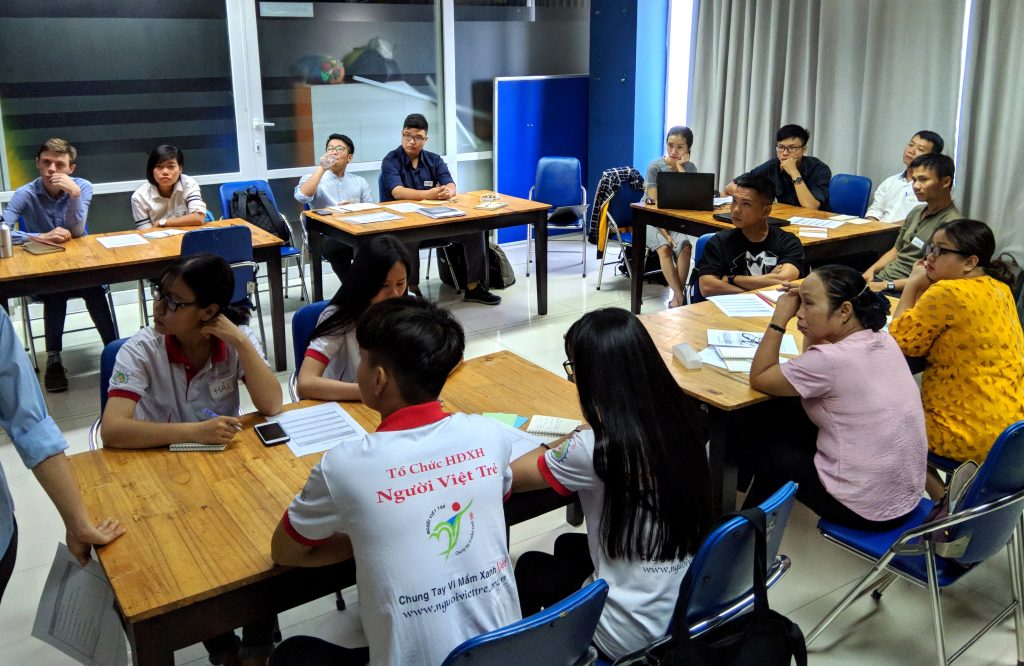
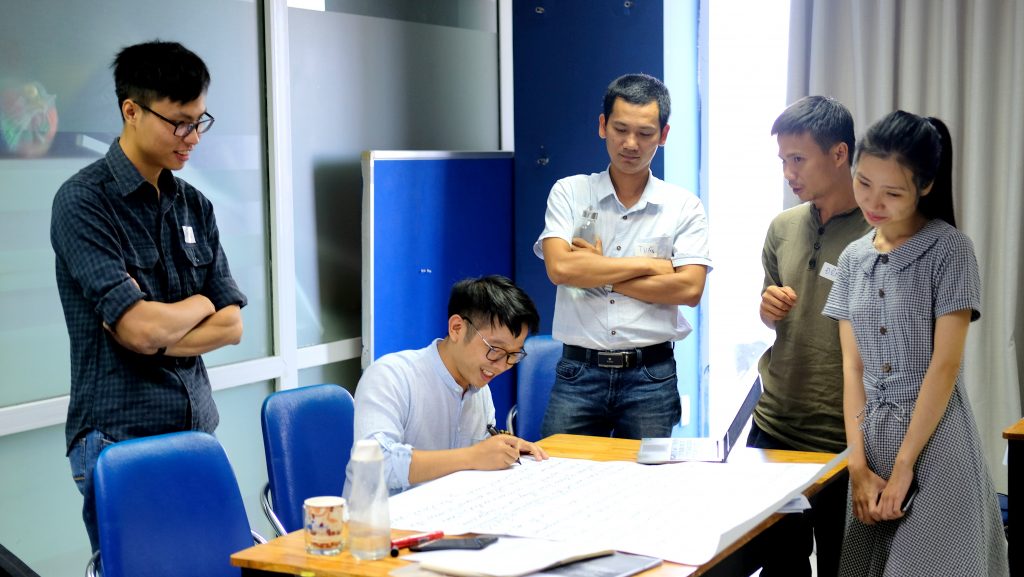
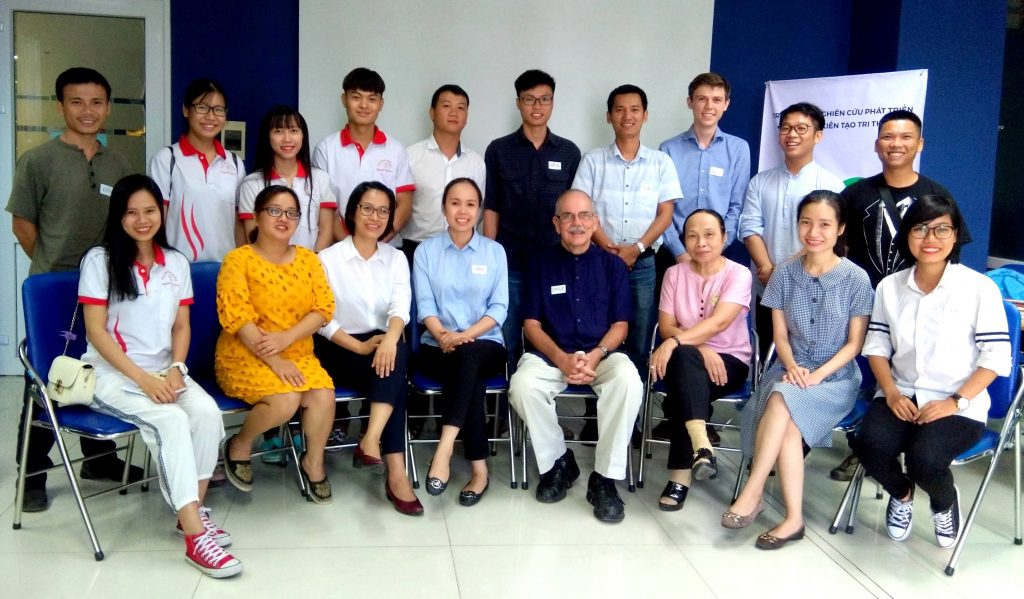
On 22-23 May 2019, CKC organised the 1st training on “Preparing a Business Plan and Writing a Successful Proposal” for nearly 25 participants at iLead AMA Hue English Language Center, Hue City. They represented a range of organisations from Hue including NGO’s (CKC, CODES, Hearts for Hue, I Love Hue, Climate Change Research Centre), Thua Thien Hue Child Protection Association, HUEFO, HUSTA, and a young professionals start-up group. The training was presented by Mr. Philip Thomas – CKC’s Business Development Advisor.
On the first day of training, Philip explained that NGO’s, local authorities, government departments, teams and businesses can all benefit from preparing a business plan which involves a written statement, a vision for the future, and specific steps or actions to achieve that vision. Business plans are particularly helpful for start-up organisations (like CKC) and for organisations facing change due to reduced budgets or restructuring.
On the second day of training, all participants were introduced about the rules would also assist applications for jobs and scholarships, and then described eight steps to prepare a successful funding proposal including Be selective, Know your deadline, Plan ahead, Make it a team approach, Get feedback – and use it, Know your audience, Be positive and upbeat, and Keep it short.
Colleagues then participated in a practical session where they worked individually and then in pairs to write an opening paragraph for a proposal. They focused on using confident and positive language, clearly and concisely defining the problem and then their response to the problem, in order to quickly get the attention of the reader – which is vital when there maybe dozens if not hundreds of applications. They then presented their work to the group who asked questions and provided feedback.
Participants were offered a free 1-hour consultation with CKC to discuss their funding proposals or for general advice after the training.
On August 20th 2019, the Center for Knowledge Co-creation and Development Research (CKC) met with local representatives at the People’s Committee of Quang Dien District, to launch a new project. The project is “Empowering Women to Build a Strong and Sustainable Village” and is based in Ngu My Thanh Village. It is funded by Australian Volunteers International (AVI) and will run for six months. The project is proposed and implemented by CKC.
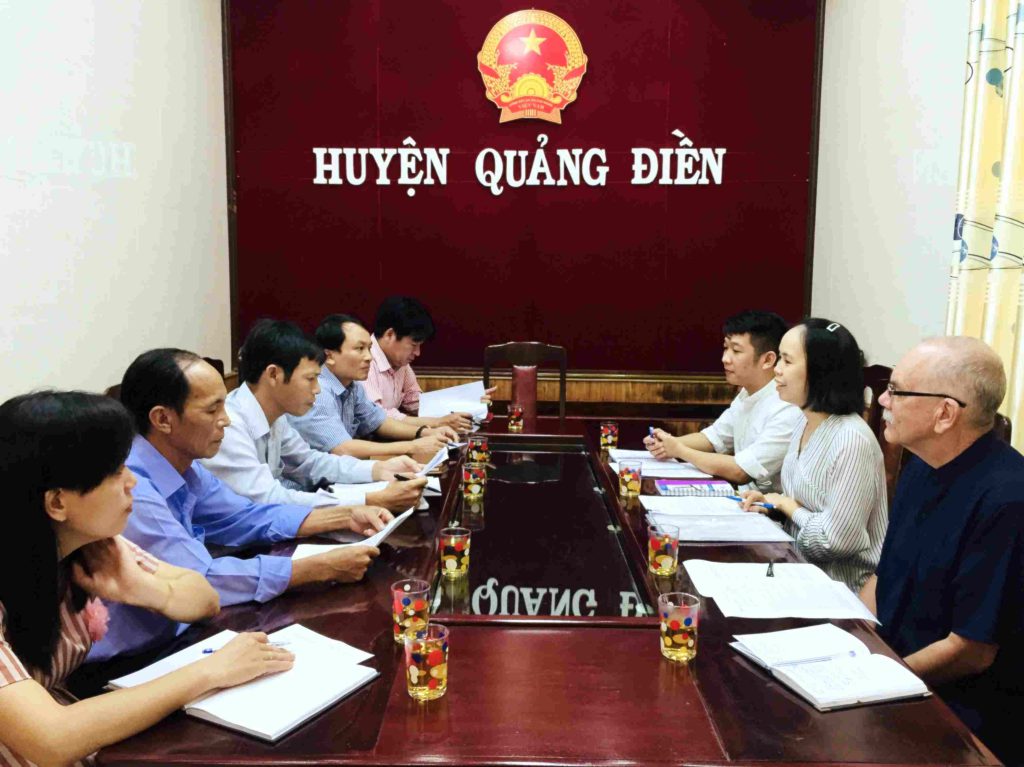
Attending the meeting, those present were the Director of CKC – Mrs. Nguyen Ngoc Khanh Van, the Chairman of Quang Dien District People’s Committee – Mr. Nguyen Dinh Duc, the Vice Chairman of Quang Loi Commune People’s Committee – Mr. Nguyen Hien, the Head of the Division of Natural Resources and Environment of the District – Mr. Hoang Tuan Nam, the Village Head of Ngu My Thanh – Mr. Nguyen Ty, the Business Development Advisor for CKC – Mr. Philip Thomas and other officers.
At this meeting, CKC listened to the local authority’s instructions on how best to implement the upcoming project’s activities. Speaking at the meeting, the Chairman of the District People’s Committee – Mr. Nguyen Dinh Duc – highly appreciated the efforts of CKC and agreed to co-work with them on project implementation. He also stressed that the project is in accordance with the orientation and planning for the province and district. He noted the “Green Sunday Campaign” launched by the Chairman of the Provincial People’s Committee at the start of 2019 and the “Say no to plastic bags and single-use plastic products” movement of the District in early July 2019. These campaigns raise awareness of people about environmental protection and action on reducing plastic waste, and helping to build the city of “Heritage, culture, ecology, scenery and environmental friendliness”.
“Empowering Women to Build a Strong and Sustainable Village” Project in Ngu My Thanh Village is funded by AVI and was approved by the Provincial People’s Committee in the Decision No. 1831/QD-UBND on 30 July 2019. The goal of the project is to improve the environment through enhancing public awareness and changing locals’ habits; improving the infrastructure for waste management and separation in markets, wharfs, lagoons and local tourist boats; and providing local women with rattan bags as a replacement for single-use plastic bags. The project aims to build an environmentally friendly community and to attract more visitors to support local tourism.
Quang Dien has potential for services and tourism development based on the Tam Giang lagoon system. The plan for the District is to promote heritage values and the outstanding local culture while preserving and protecting the environment. The project is expected to be a successful model which will spread out to other localities and which will build up “a bright – green – clean and waste-free Thua Thien Hue”.
Article & Photo: CKC